How to calculate groundspeed using the HSI or DI
By Rory Bennett (ATPL, FI: CPL, IR, ME, UPRT, FIC) · Published 25 May 2026
Direct answer
Once you have the wind-corrected heading, look at the angle from the wing tip (heading ±90°) to the wind on the HSI or DI. 60° or above: take the full wind speed as head or tailwind. 0° to 60°: that angle as a fraction of 60, times total wind speed. Add a tailwind, subtract a headwind, from TAS[1].
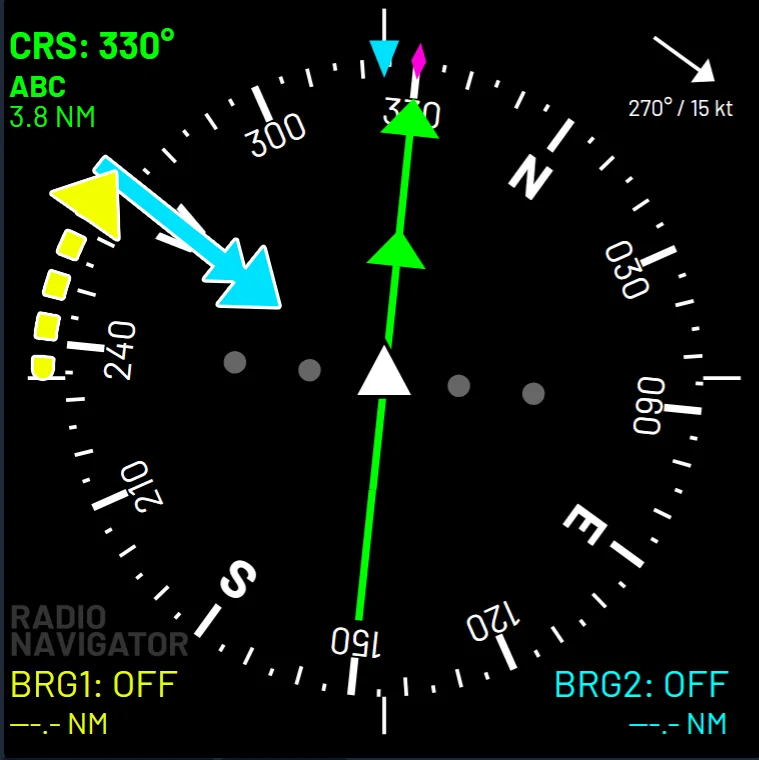
The full technique in under a minute. Transcript is below the video.
Video transcript
Why the wing tip?
Drift and groundspeed are resolved on different axes. Drift is a cross-track component, measured from the track-to-wind angle. Groundspeed is a head/tail component on the aircraft itself, measured from the wing-tip-to-wind angle - this allows us to use the same clock code.
The wing tip is heading ±90°. Once you have the wind-corrected heading from the wind correction step, the wing tips are just 90° either side of it on the rose - many DI or HSIs have handy lubber lines here.
You will use this on diversions, VFR navigation, ETA updates en route, hold timing corrections, and any time you need an in-flight groundspeed without GPS. To practise the read, the free HSI simulator gives you a live rose and a wind you set yourself.
How to read the wing-tip angle
Take the angle from the wing tip to the wind:
- 60° or above: take the full wind speed as head or tailwind.
- 0° to 60°: the angle as a fraction of 60 is the fraction of total wind that applies as head or tailwind.
Use whichever wing tip is on the same side as the wind: the right wing tip if the wind is from the right, the left wing tip if the wind is from the left.
Headwind sits forward of the wing-tip line and subtracts from TAS. Tailwind sits aft of the wing-tip line and adds to TAS.
Worked example
Scenario: TAS 120 kt, wind 30 kt from 060°, wind-corrected heading 360°.
Wing tip: right wing tip is at 090°. Angle from 090° to the wind at 060° is 30°.
Clock code: 30 ÷ 60 = 0.5. Component = 0.5 × 30 kt = 15 kt.
Head or tail: the wind sits forward of the right wing tip, so it is a headwind. Groundspeed = 120 − 15 = 105 kt.
Common mistakes
- Measuring from track instead of wing tip. Drift uses the track-to-wind angle. Groundspeed uses the wing-tip-to-wind angle, on the wind-corrected heading axis. Switching reference axis when you switch from drift to groundspeed is the whole point of the technique.
- Forgetting to use the wind-corrected heading. The wing tip is heading ±90°, where heading is the wind-corrected heading you just worked out - not the track.
- Applying a fraction of max drift instead of a fraction of the wind speed. The clock-code fraction for groundspeed multiplies the total wind speed, not max drift. Max drift is for cross-track drift; the wing-tip rule resolves head/tail wind component.
Practise this in the simulator
Use the simulator to practise this procedure. You can change the wind and monitor the instruments in your browser.
7-day free trial, no card required. Includes Just Fly, the Intercept Trainer and the Hold Visualiser. Reverts to the free tier when it ends; you are never charged automatically.
More about the tools for this topic:
- HSI simulator gives you the DME and the clock you need to time a groundspeed check.
Check your understanding
Read each question. Decide on your answer. Then select Show answer to check it.
Show answer
Show answer
Show answer
Frequently asked questions
Why the wing tip and not the heading?
Groundspeed is resolved on the heading axis. The component of wind along the heading axis is what adds to or subtracts from TAS. The wing tip is the perpendicular to the heading axis, so the angle from wing tip to wind tells you how much of the wind sits along the heading axis as head or tail.
Does the wing-tip rule work without an HSI?
Yes, on any DI. Picture the heading at 12 o’clock and the wing tips at 9 and 3 on the compass card. Measure the angle from the nearer wing tip to the wind direction and apply the clock code.
Why a fraction of total wind, not max drift?
You are resolving the wind into a head or tail component on the aircraft axis, not into a cross-track drift component. Different axis, same clock-code shortcut, but the thing the fraction multiplies is the wind speed itself, not max drift.
How do I tell head from tail?
If the wind comes from in front of the wing-tip line (forward of 9-to-3), it is a headwind: subtract. If it comes from behind the wing-tip line (aft of 9-to-3), it is a tailwind: add.
Sources
- Good Flying Made Easy, How to calculate groundspeed using the HSI or DI. youtube.com/watch?v=bpZgORz0T80
- Good Flying Made Easy, Wind Corrections: How to calculate a wind corrected heading and groundspeed (long-form companion). youtube.com/watch?v=32Ty5XRZbe4
Related articles
This article is for study. Follow the instructions from your qualified flight instructor. Use current charts, procedures, and the regulations from your aviation authority.
© 2026 RHBA Radio Navigator. All rights reserved.