2D, 3D, Type A and Type B approaches explained
By Rory Bennett (ATPL, FI: CPL, IR, ME, UPRT, FIC) · Published 4 June 2026 · Updated 5 June 2026
Direct answer
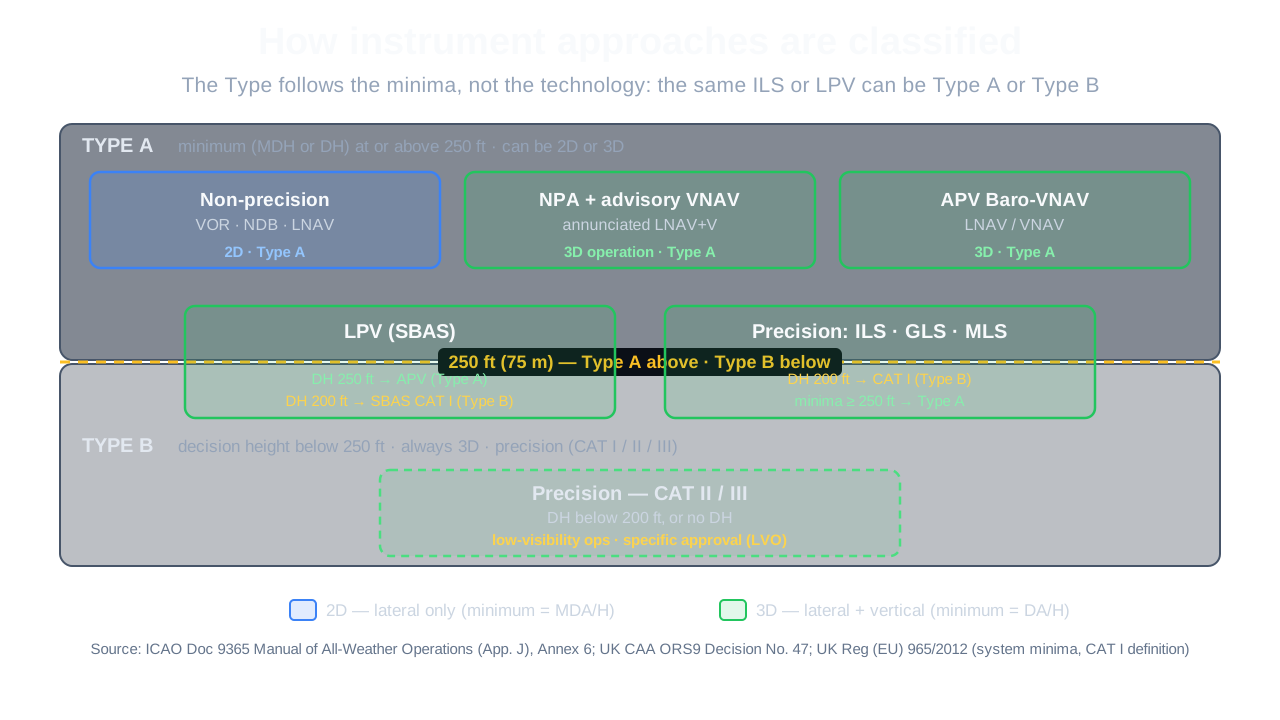
Instrument approaches are classified two ways. By guidance: a 2D approach operation has lateral guidance only; a 3D approach operation adds vertical guidance. By minima: a Type A operation has a minimum (MDH or DH) at or above 250 ft; a Type B operation has a decision height below 250 ft. Non-precision approaches are 2D Type A, APV is 3D Type A, and precision approaches are 3D Type A or B[5].
| Approach | Guidance | 2D / 3D | Type (set by the minima) |
|---|---|---|---|
| Non-precision (VOR, NDB, LNAV) | Lateral only | 2D | Type A |
| Non-precision flown with advisory VNAV (e.g. LNAV+V) | Lateral + advisory vertical | 3D operation | Type A |
| APV: Baro-VNAV (LNAV/VNAV) | Lateral + vertical | 3D | Type A |
| LPV (SBAS) | Lateral + vertical | 3D | Type A at DH 250 ft; Type B (SBAS CAT I) at DH 200 ft |
| Precision: ILS, GLS, MLS | Lateral + vertical | 3D | Type B at DH 200 ft (CAT I); Type A if minima at or above 250 ft |
| Precision: CAT II / III (low-visibility ops) | Lateral + vertical | 3D | Type B |
What did the All Weather Operations recategorisation change?
The ICAO All Weather Operations (AWO) framework separates two ideas that the old "precision versus non-precision" shorthand ran together: how a procedure is designed, and how an approach is actually flown. An approach operation is what you do in the aeroplane; the procedure on the chart is what the State designed. Every approach is then described by answering two separate questions: what navigation guidance is in use (2D or 3D), and how low are the minima (Type A or Type B)[1][2].
In the UK this scheme came into force on 30 October 2025, through UK CAA Official Record Series 9 Decision No. 47, which adopted the amended Acceptable Means of Compliance and Guidance Material to UK Regulation (EU) 965/2012[5]. The older words have not vanished; non-precision, APV and precision are still defined, but they now sit inside the 2D/3D and Type A/Type B structure rather than competing with it.
Why did approach minima change from traditional to flexible?
The recategorisation is one part of a larger shift in All Weather Operations, from traditional to flexible aerodrome operating minima. The fourth edition of the ICAO Manual of All-Weather Operations was brought into line with Annex 6 Amendments 37B, 32B and 18B: it introduced the new approach classification terminology and, alongside it, the concept of operational credits and the flexible minima they make possible[2].
Traditionally, aerodrome operating minima were strictly limited by the type of approach procedure (NPA, APV or PA) and the category of operation. CAT I, for example, bottoms out at an RVR of 550 m; below that the operation becomes CAT II. Those minima, and the aerodrome facilities required to support them, were designed around a "basic" aircraft carrying only the minimum equipment for the operation[2][1]. The procedure type effectively dictated the minimum, which left no way to reward an aeroplane that carried more capability than the bare minimum.
Annex 6 now opens up a more flexible approach by allowing operational credits for an "advanced" aircraft, one carrying equipment beyond the basic requirement, such as an autoland-capable autopilot, a head-up display (HUD), or an enhanced, combined or synthetic vision system (EVS/CVS/SVS). An operational credit means lowering the aerodrome operating minima, satisfying the flight visibility requirement, or requiring fewer ground facilities, when compensated by the aircraft's airborne capability[1][2]. A certified EVS, for instance, can let the pilot satisfy the visibility requirement using enhanced flight visibility even when the reported natural visibility is below the value prescribed for the procedure.
Here is the link back to this article. ICAO is explicit that granting an operational credit does not change the classification of the approach procedure, nor the type or category of operation[2]. That is exactly why the classification had to be separated from the equipment. The 2D/3D and Type A/Type B labels describe the operation and its minima in a way that does not depend on what the aircraft is carrying; operational credits then sit on top, letting a better-equipped aeroplane fly to lower minima on the same, unchanged procedure. The clean classification this article sets out is the framework that makes those flexible minima coherent.
What is a 2D or 3D approach operation?
A 2D approach operation uses lateral navigation guidance only. Its minimum is a minimum descent altitude or height (MDA/H), below which you may not descend without the required visual reference. A 3D approach operation uses both lateral and vertical guidance, and its minimum is a decision altitude or height (DA/H), at which you decide to continue or go around[2].
The important point is in the word operation. 2D and 3D describe what guidance you are flying, not just how the procedure was drawn. A non-precision approach procedure flown as a continuous descent final approach (CDFA) with vertical path guidance calculated by on-board equipment is considered a 3D approach operation; the same procedure flown with a manually-calculated rate of descent is a 2D operation[5][3]. That is exactly the case in the opening scenario: an LNAV procedure flown with an avionics advisory glidepath, often annunciated "LNAV+V", is a 3D operation even though the underlying procedure is a 2D non-precision approach. ICAO sets out how an operation is classified by its guidance and minima in the Manual of All-Weather Operations[2].
Type A vs Type B: what is the difference?
Type A and Type B answer the second question, and they are defined purely by the minima[5][1]:
- A Type A instrument approach operation has an MDH or a DH at or above 250 ft (75 m).
- A Type B instrument approach operation has a DH below 250 ft, and is subdivided into CAT I, CAT II and CAT III.
Notice what this does not depend on: the equipment, whether the approach is precision or non-precision, or whether it is 2D or 3D. A Type A operation can be 2D or 3D; a Type B operation is always 3D. The boundary is the 250 ft minimum, full stop.
How do non-precision, APV and precision approaches map on?
The familiar procedure categories slot cleanly into the new scheme. The UK CAA guidance defines them as follows[5][3]:
- Non-precision approach (NPA): an instrument approach procedure designed for a 2D Type A operation, which may be flown using the CDFA technique. VOR, NDB and GNSS LNAV approaches are NPAs. The lateral guidance is ordinary radial or bearing tracking, which you can drill in the VOR simulator.
- Approach with vertical guidance (APV): a performance-based navigation procedure that adds vertical guidance, so it is a 3D operation. Baro-VNAV (LNAV/VNAV) is the clean case: its lowest decision height is 250 ft, so it is a 3D Type A operation. An APV is not, of itself, a precision approach, even though it gives you a glidepath.
- Precision approach (PA): a procedure based on navigation systems that meets the precision criteria, and is 3D Type A or Type B depending on the minima[5]. Precision approaches are ILS, the GBAS landing system (GLS), MLS and SBAS CAT I; the ILS and GBAS signal specifications are set in ICAO Annex 10[4]. An ILS or an LPV flown to a 200 ft decision height is a CAT I precision approach, and therefore a Type B operation[6].
Where do CAT I, II and III fit?
Type B is subdivided by decision height and runway visual range (RVR)[5]:
- CAT I: a DH not lower than 200 ft, with a visibility not less than 800 m or an RVR not less than 550 m.
- CAT II: a DH lower than 200 ft but not lower than 100 ft, and an RVR not less than 300 m.
- CAT III: a DH lower than 100 ft, or no DH, and an RVR less than 300 m or no RVR limitation.
CAT I is the everyday Type B precision approach. CAT II and CAT III are low-visibility operations (LVO): in the UK rules, LVO begins below CAT I, at an RVR less than 550 m or a DH less than 200 ft, and requires a specific approval[5]. The detail of LVO is beyond the scope of this article; the point here is simply that CAT II and CAT III are the low-visibility end of Type B, not a separate classification.
How does the classification set your minima (Part-NCO and Part-CAT)?
The classification is not academic. Whether an approach is Type A or Type B changes the add-ons applied to the approach minima when you plan a destination alternate. Under Part-NCO (NCO.OP.143), for a Type B approach (DH below 250 ft) the forecast at the alternate must show the ceiling at least 200 ft above the minimum and visibility at least 1500 m; for a Type A approach (DH or MDH at or above 250 ft) the figures rise to 400 ft and 3000 m[6].
Part-CAT applies the same idea (AMC6 CAT.OP.MPA.182): for a destination alternate, a Type B approach adds 200 ft to the DA/H and 800 m to the RVR/VIS, while a Type A approach adds 400 ft and 1500 m[6]. In both regimes the less capable, higher-minima Type A approach demands the larger margin at the alternate, which is worth remembering when you choose between two aerodromes.
For how these planning minima fit into a full IFR flight plan, see UK CAA IFR flight planning. For more procedures in this cluster, return to the instrument procedures index.
Common mistakes
- Assuming a precision approach means an ILS and nothing else. A precision approach (PA) is any approach designed for a 3D operation that meets the precision criteria, which includes the GBAS landing system (GLS), MLS and SBAS CAT I (an LPV flown to a 200 ft decision height) as well as ILS. The classification describes the operation and its guidance, not one particular ground installation.
- Calling every approach without a ground-based glidepath a 2D approach. A non-precision approach procedure flown as a continuous descent final approach with on-board-computed vertical guidance, for example an LNAV approach flown with an advisory glidepath, is conducted as a 3D approach operation. Whether you are flying 2D or 3D depends on the vertical guidance you actually use, not on whether the procedure has a ground glidepath.
- Assuming any approach with a glidepath is a precision approach. An approach with vertical guidance (APV) such as Baro-VNAV (LNAV/VNAV) provides a glidepath but is a 3D Type A operation, not a precision approach. LPV (SBAS) is the exception that proves the rule: published to a 250 ft decision height it is an APV (Type A), but published to a 200 ft decision height it is SBAS CAT I, a precision Type B operation.
- Thinking Type B only means CAT II and CAT III. Type B is any instrument approach operation with a decision height below 250 ft, and that includes CAT I. A standard ILS flown to a 200 ft decision height is already a Type B operation. CAT II and CAT III are the low-visibility subdivisions of Type B that need a specific approval.
- Assuming an ILS is always a Type B approach. The Type follows the minima, not the equipment. A normal ILS to a 200 ft decision height is Type B, but an ILS whose minima are raised to a decision height or MDH of 250 ft or above, for obstacle or facility reasons, is a Type A operation. The same is true in reverse for LPV.
- Believing an advisory glidepath such as LNAV+V lowers your minimum. Advisory vertical guidance makes the approach a 3D operation but does not change the published minimum or assure obstacle clearance below it. On an LNAV approach you still use the published MDA/H as your minimum and treat it as a hard floor unless you have the required visual reference.
Practise this in the simulator
Use the simulator to practise this procedure. You can change the wind and monitor the instruments in your browser.
7-day free trial, no card required. Includes Just Fly, the Intercept Trainer and the Hold Visualiser. Reverts to the free tier when it ends; you are never charged automatically.
More about the tools for this topic:
- HSI simulator drives the deviation bar from an ILS localiser as well as a VOR radial, so you can fly the lateral part of either approach type.
Check your understanding
Read each question. Decide on your answer. Then select Show answer to check it.
Show answer
Show answer
Show answer
Frequently asked questions
What is the difference between a 2D and a 3D approach operation?
A 2D approach operation uses lateral navigation guidance only, and its minimum is a minimum descent altitude/height (MDA/H). A 3D approach operation uses both lateral and vertical guidance, and its minimum is a decision altitude/height (DA/H). The distinction is about the guidance used in the operation, not only the procedure design.
What is the difference between a Type A and a Type B approach?
Type A and Type B describe the minima. A Type A instrument approach operation has a minimum descent height or decision height at or above 250 ft (75 m). A Type B operation has a decision height below 250 ft and is subdivided into CAT I, CAT II and CAT III. The classification is independent of the technology used.
Is a non-precision approach always a 2D approach?
No. A non-precision approach procedure is designed for a 2D Type A operation, but if you fly it as a continuous descent final approach with on-board-computed vertical guidance it is conducted as a 3D approach operation. Flown with a manually-calculated descent rate it remains a 2D operation.
Is an LPV or APV approach a precision approach?
It depends on the minima. An approach with vertical guidance (APV) such as Baro-VNAV (LNAV/VNAV) gives you a glidepath but is a 3D Type A operation, not a precision approach. LPV (SBAS) is an APV when published to a 250 ft decision height, but when published to a 200 ft decision height it is classified as SBAS CAT I, a precision approach and a Type B operation. Precision approaches are ILS, GLS, MLS and SBAS CAT I.
Why did All Weather Operations introduce 2D/3D and Type A/Type B classifications?
To support flexible aerodrome operating minima and operational credits. Traditionally, minima were strictly limited by the type of approach procedure (NPA, APV, PA) and the category of operation, based on a "basic" aircraft carrying only the minimum equipment. ICAO Annex 6 now allows operational credits, lower minima, fewer ground facilities, or a satisfied flight-visibility requirement, for an "advanced" aircraft carrying extra capability such as a HUD, an enhanced/synthetic vision system or autoland. Because granting a credit does not change the classification of the procedure or the type/category of operation, the classification had to be defined independently of equipment, which is what the 2D/3D and Type A/Type B scheme does.
When did these approach classifications come into force in the UK?
The All Weather Operations changes came into UK force on 30 October 2025 through UK CAA Official Record Series 9 Decision No. 47, which adopted the amended Acceptable Means of Compliance and Guidance Material to UK Regulation (EU) 965/2012. The underlying classification comes from the ICAO All Weather Operations provisions in Annex 6 and the Manual of All-Weather Operations (Doc 9365).
Does the approach classification affect my alternate planning minima?
Yes. Whether an approach is Type A or Type B changes the add-ons applied to the approach minima when you plan a destination alternate. Under Part-NCO (NCO.OP.143) a Type B approach needs the forecast ceiling at least 200 ft above the minimum and visibility at least 1500 m, while a Type A approach needs 400 ft and 3000 m. Part-CAT applies similar additives under AMC6 CAT.OP.MPA.182.
Sources
- International Civil Aviation Organization, Annex 6 to the Convention on International Civil Aviation, Operation of Aircraft, Part I. Definitions and standards for instrument approach operations (Type A and Type B; 2D and 3D), and the provision for operational credits and flexible aerodrome operating minima (Amendments 37B, 32B and 18B). No public URL; cited by document and section.
- International Civil Aviation Organization, Doc 9365, Manual of All-Weather Operations, Fourth Edition (2017). Section 2.1, "Traditional versus flexible aerodrome operating minima for approach operations" (operational credits; "basic" versus "advanced" aircraft) and Section 6.9 (operational credits do not change the procedure classification), and Appendix J (classification of an instrument approach operation by its lowest operating minima). No public URL; cited by document and section.
- International Civil Aviation Organization, Doc 8168, Procedures for Air Navigation Services — Aircraft Operations (PANS-OPS), Volume I, Flight Procedures. Non-precision (NPA), approach with vertical guidance (APV) and precision (PA) procedures and the continuous descent final approach (CDFA) technique. No public URL; cited by document and section.
- International Civil Aviation Organization, Annex 10 to the Convention on International Civil Aviation, Aeronautical Telecommunications, Volume I, Radio Navigation Aids. ILS and GBAS signal specifications underpinning precision approaches. No public URL; cited by document and section.
- UK Civil Aviation Authority, Official Record Series 9, Decision No. 47 (9 May 2025, in UK force 30 October 2025): decision adopting and amending AMC and GM to UK Regulation (EU) 965/2012. GM36 and GM37 to Annex I (Definitions) classify instrument approach procedures (NPA, APV, PA) and operations (Type A, Type B, CAT I/II/III). caa.co.uk/our-work/publications/documents/content/ors9-no-0047
- UK Civil Aviation Authority, UK Regulation (EU) 965/2012 (Air OPS), as published in the CAA Regulatory Library: Annex I Definitions (the Category I approach operation, including GNSS using SBAS with a decision height not lower than 200 ft) and the system minima table (lowest DH/MDH by facility, including the LPV 200 ft / 250 ft condition); Part-NCO NCO.OP.143 and Part-CAT AMC6 CAT.OP.MPA.182 (destination-alternate planning minima for Type A and Type B operations). regulatorylibrary.caa.co.uk/965-2012
Related articles
This article is for study. Follow the instructions from your qualified flight instructor. Use current charts, procedures, and the regulations from your aviation authority.
© 2026 RHBA Radio Navigator. All rights reserved.