How to Determine Hold Entry
By Rory Bennett (ATPL, FI: CPL, IR, ME, UPRT, FIC) · Published 14 May 2026
Direct answer
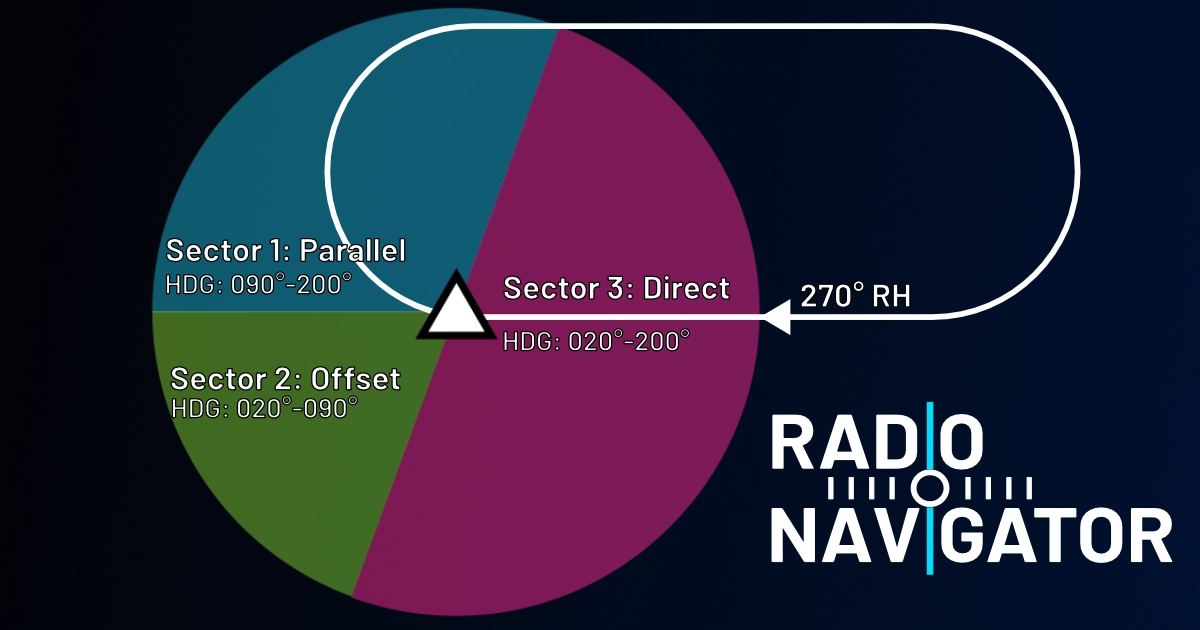
For an ICAO PANS-OPS holding pattern, the entry is determined solely by your aircraft heading approaching the holding fix, measured against the hold inbound course. The entries are divided into three sectors: Sector 1 (Parallel) Sector 2 (Offset) Sector 3 (Direct) There is a 5° leeway either side of every boundary, so if your heading is on the line you may choose either entry[1].
| Sector | Width | When your heading is... | First turn at the fix |
|---|---|---|---|
| 1: Parallel | 110° | Heading towards non-holding side, away from the inbound | Opposite to the hold direction, free-air track the reciprocal of inbound |
| 2: Offset (teardrop) | 70° | Heading towards the holding side, broadly facing the outbound | Into the hold, tracking the 30° offset QDR from the fix |
| 3: Direct | 180° | Generally facing the inbound or close to it | In direction of hold, straight onto outbound |
Hold entry walkthrough
A walkthrough of all three ICAO PANS-OPS hold entry sectors: parallel, offset, and direct. Includes the HSI trick for reading the entry off your instrument. The full transcript is below the video for accessibility and search.
Video transcript
What are the three hold entry sectors?
ICAO defines three hold entry sectors, numbered 1, 2 and 3, each corresponding to one entry technique[1]:
- Sector 1: Parallel. 110° wide.
- Sector 2: Offset. 70° wide. Sometimes called a "teardrop" entry (FAA term) because of the shape of the manoeuvre.
- Sector 3: Direct. 180° wide. The remaining half of the circle, covering all headings that are pointing generally inbound or close to it.
The aim of every entry is to establish the inbound track before passing the fix and turning outbound in the hold. Which entry is most efficient depends on which direction you are approaching from, or more precisely, on your heading when you cross the fix.
How to visualise the hold entry sectors
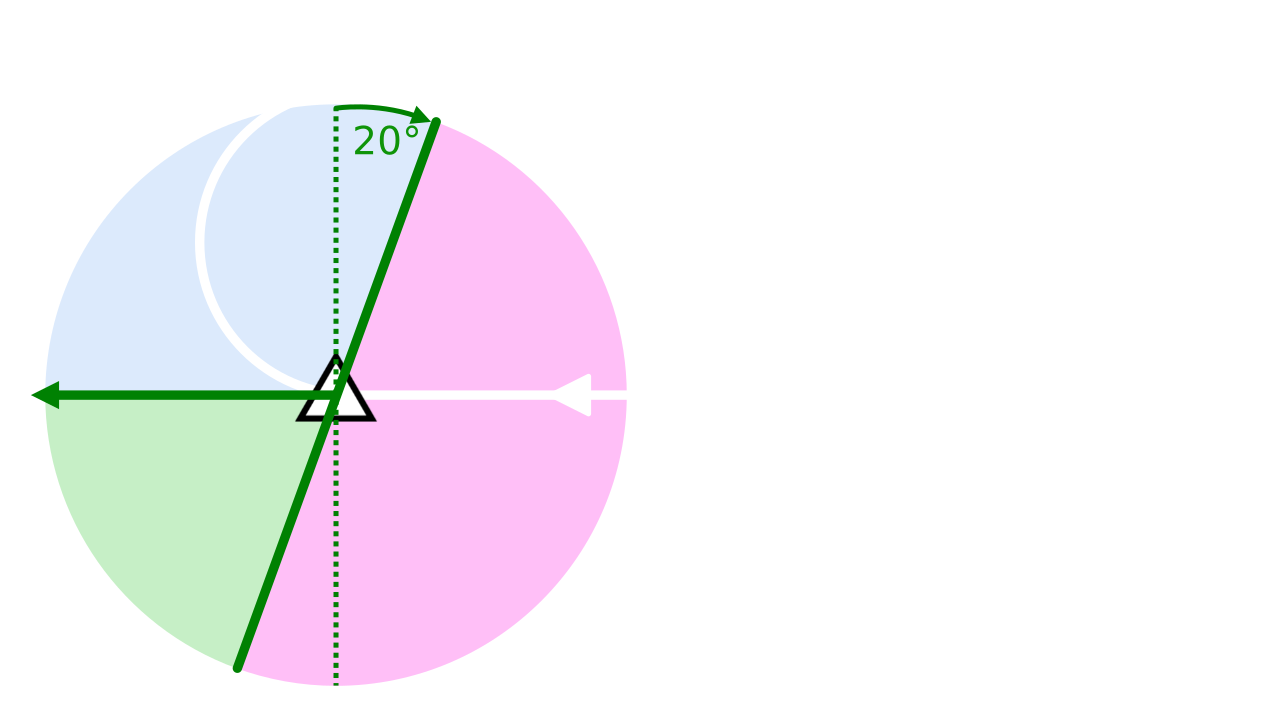
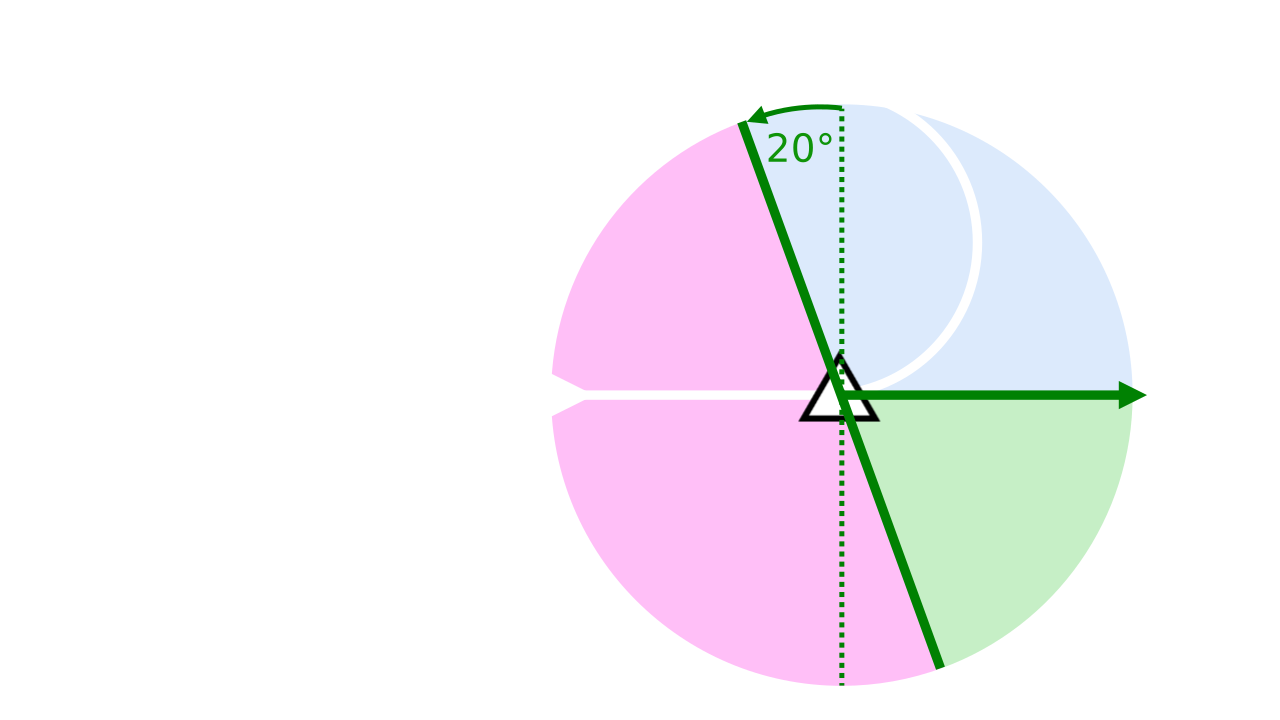
A simple geometric construction lets you sketch the three sectors from any inbound course[1]:
- Extend the inbound track past the fix to get the inbound/outbound axis.
- Draw a perpendicular bisector through the fix (a line 90° to the inbound axis).
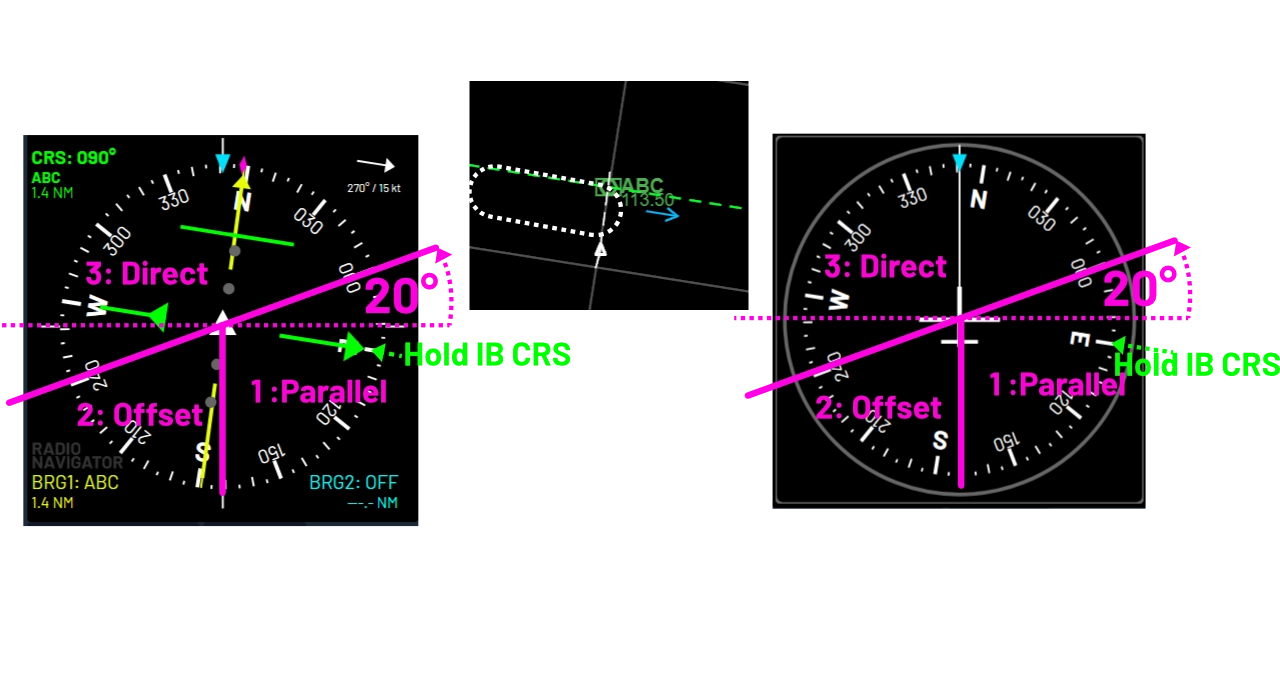
- Tilt that perpendicular line 20° in the direction of the outbound turn (right for a standard hold, left for a non-standard hold).
You now have your three sectors. The tilted perpendicular plus the inbound axis carve the plane into the parallel sector (110°), the offset sector (70°), and the direct sector (180°). The 20° tilt is what produces the asymmetric 70°/110° split.
Is hold entry based on heading or track?
This is a common misunderstanding with hold entries. The published diagrams lead people to believe hold entries can be determined from a plan view. However, the exact wording of 8168 PANS-OPS is "The entry into the holding pattern shall be according to heading in relation to the three entry sectors shown" The entry sector is defined by aircraft heading at the moment of fix crossing, not directly by where you came from.
Consider a hold 180° RH with the aircraft approaching on a QDM of 015°. Position alone suggests a Parallel entry. However, with a strong wind from the West (f.e. 270/35kts at 90KTAS) the aircraft Heading could push it firmly into the Offset sector.
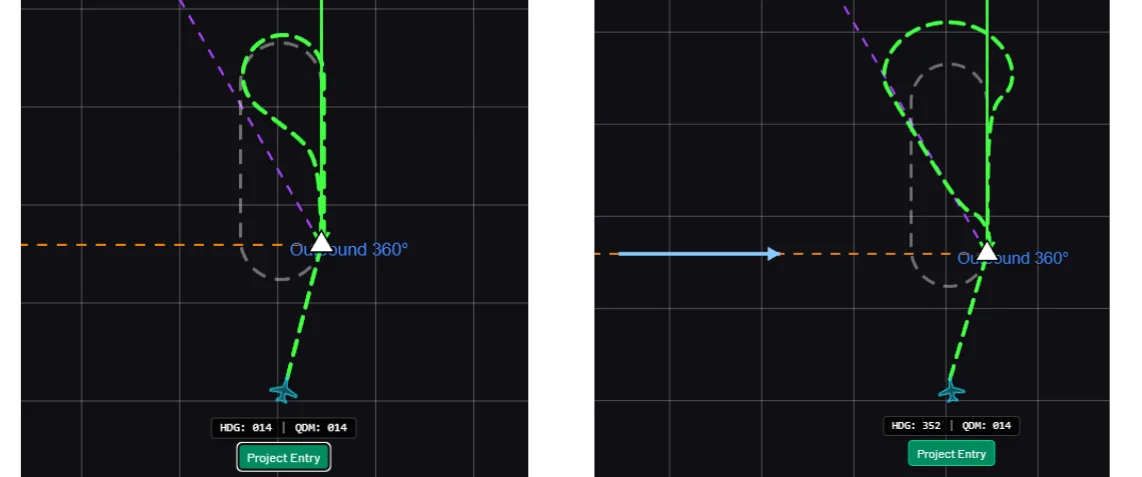
Try dialling in different wind speeds in the Hold Visualiser and watch how the required heading shifts between sectors.
How to identify hold entry sector
- Note the hold inbound course from the clearance or chart. This is the track TO the fix.
- Note the turn direction. "Right turns" is a standard hold. "Left turns" is non-standard. Though you'll likely find just as many left holds as right!
- Read your heading when tracking to the fix.
- Picture the three sectors using the tilt-the-perpendicular construction above, or use the HSI trick below to read it directly off the instrument.
- Find which sector your heading falls into. If you are within 5° of a boundary, either entry is acceptable.
How to fly each hold entry
Sector 1: Parallel entry
The parallel entry involves two turns, both in the opposite direction to the hold[1].
- On reaching the fix, turn in the opposite direction to the hold and free-air track the reciprocal of the inbound track, paralleling the inbound on the non-holding side.
- When wings level on that heading, start the timer. Fly for one wind-corrected minute (1.5 minutes above 14,000 ft).
- At the end of the timed leg, make a further turn in the opposite direction to the hold to intercept the inbound course back to the fix.
The intercept is typically a 45° to 60° angle onto the inbound course. The parallel entry can be challenging: knowing when to roll out of the intercept takes practice and good judgement. The Holding Pattern Trainer grades exactly this.
Full walkthrough, common mistakes, and a worked example: how to fly the parallel hold entry →
Watch: parallel entry
Video transcript
Sector 2: Offset entry ("teardrop")
The offset entry tracks a 30° offset radial from the fix. Pilots and instructors sometimes call this offset QDR the gate; the term is not used in ICAO Doc 8168.
- On reaching the fix, turn to track 30° offset from the inbound on the holding side. For a right-hand hold, this is the outbound course minus 30° (e.g. outbound 090°, gate 060°). For a left-hand hold, outbound plus 30°.
- Note: this is a QDR from the fix, not a free-air track. Establish and maintain the bearing FROM the fix (QDR.)
- On reaching the heading wings level, start the timer. Fly for one wind-corrected minute (1.5 minutes above 14,000 ft).
- At the end of the minute, turn in the direction of the hold to intercept the inbound course.
Full walkthrough, the 30° offset calculation, and a worked example: how to fly the offset ("teardrop") hold entry →
Watch: offset entry
Video transcript
Sector 3: Direct entry
The (apparently) simplest of the three. On reaching the fix, turn outbound in the direction of the hold. You are now in the hold: fly the outbound leg, time one wind-corrected minute (1.5 above 14,000 ft), then turn inbound and intercept the holding course[1].
Simple is not always precise. Large angles of entry compared with the inbound course can leave you very tight in the hold once established. These "extreme direct" cases are covered in a separate article.
Full walkthrough, the abeam-vs-wings-level timing rule, and extreme direct entries: how to fly the direct hold entry →
Watch: direct entry
Video transcript
How to determine Hold Entry on HSI or DI
In flight, you don't need to sketch the geometry. The same sector picture is already drawn on your HSI or DI. Here is the trick:
- Picture a horizontal line across the HSI from 9 o'clock to 3 o'clock (left to right through the centre).
- If the hold is a right-hand hold, push the right side of the line up 20°. If it is a left-hand hold, push the left side up 20°.
- Drop a vertical line down from the centre.
- You now have the three sectors drawn over your heading indicator: the biggest is direct, the next biggest is parallel, the smallest is offset.
- Whichever sector the inbound course falls into on the HSI face is the entry you fly.
Example: for a right-hand hold, you are flying a heading of 300° toward the fix, and the inbound course is 270° (west). The HSI top represents your 300° heading. The 270° course pointer sits about 30° to the upper-left of the HSI centre. With the right-hand tilt applied (3 o'clock side up), that point falls in the direct sector. Direct entry.
The trick works because the HSI rotates with your heading: the sectors stay anchored to the holding side regardless of which way you are pointing. As long as you are tracking toward the fix when you read it, it is reliable.
Watch: the HSI trick
Video transcript
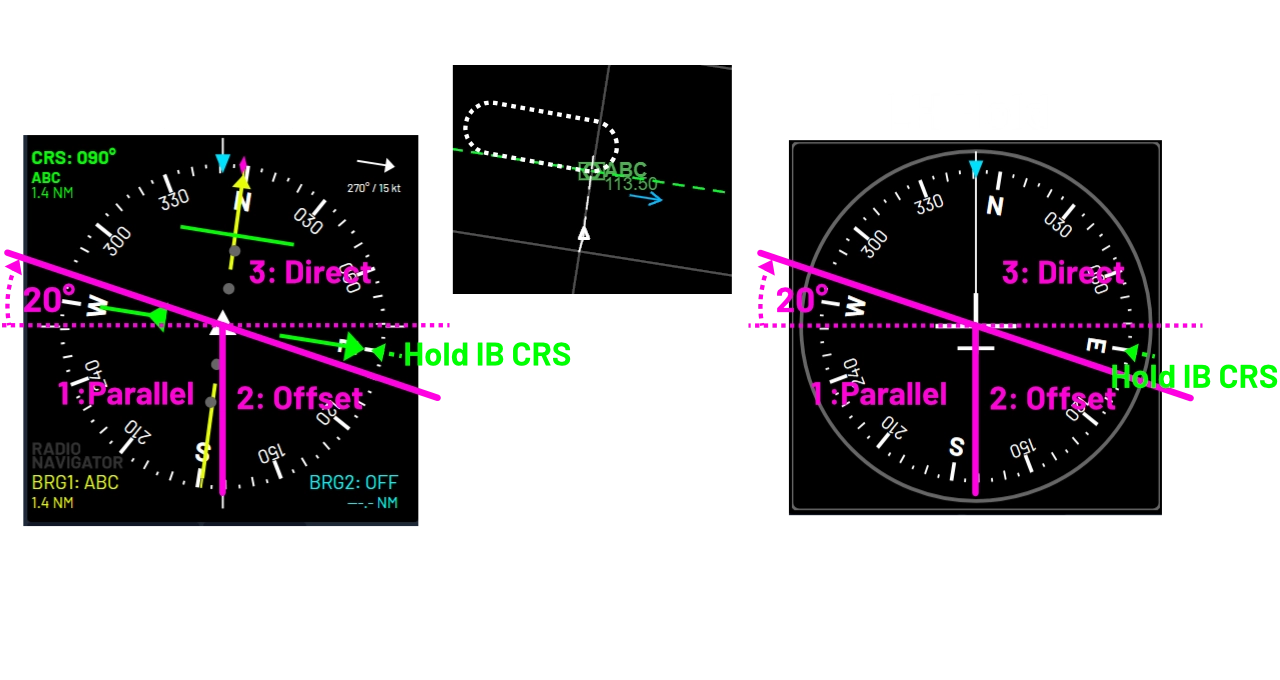
Non-standard (left-turn) holds
When a clearance specifies left turns, the racetrack mirrors to the other side of the inbound course. The 70° and 110° sectors flip with it.[1].
Tolerances and assumptions (ICAO)
The protected airspace around a hold is sized to accommodate normal entry maneuvering, wind, and pilot judgement. Specifically:
- ICAO Doc 8168 allows a ±5° tolerance on the sector boundaries. Either entry is acceptable within that band[1].
- Bank angle for entry and holding turns is the lesser of 25° bank or rate-one turn (3°/sec) under ICAO PANS-OPS[1].
- Outbound timing is 1 minute at or below 14,000 ft, 1.5 minutes above. Distance-based holds (DME or RNAV) replace timing with a leg length. Outbound can also be terminated by a limiting radial.[1].
- Wind correction is applied to both the outbound leg (to produce the correct inbound leg length) and the holding turns (compensating drift)[1].
Differences for FAA TERPS / AIM
FAA AIM and the underlying TERPS criteria use the same 70°/110° sector geometry as ICAO. The three entries (Direct, Parallel, offset) are equally recognised. The practical differences a pilot will encounter are limited to a few values and one terminological note:
- Maximum bank angle: FAA AIM and the Instrument Flying Handbook (FAA-H-8083-15B) specify the lesser of 30° bank or rate-one turn, versus ICAO's 25°[2][3].
- Altitude break for timing: AIM expresses the 1 min / 1.5 min boundary as "at or below 14,000 ft MSL", versus ICAO's "at or below 14,000 ft". Under standard atmosphere the two are equivalent[2].
- Terminology: FAA usage is "teardrop" throughout. ICAO Doc 8168 calls the same procedure an "offset entry" in its normative text, though "teardrop" is recognised in practice. Either word is acceptable in conversation; in this article we use "offset" (the ICAO canonical term), with "teardrop" appearing in quotation marks where the FAA term is specifically referenced.
- 5° sector tolerance: stated in both ICAO Doc 8168 Vol I §2.2.2 and FAA AIM. If your heading at the fix is within 5° of a boundary, either entry is acceptable[1][2].
Where else do these entries apply?
On an instrument approach, the same three sectors govern entry to a published racetrack procedure. A reversal procedure (a procedure turn or base turn) uses a different rule: you enter it from a track within 30° either side of its outbound track. The direct entry sector article covers when you can continue outbound on a reversal procedure directly, and when you fly a hold entry first.
Common mistakes
- Choosing the sector from your position instead of your heading. Under ICAO the entry is based on aircraft heading approaching the fix. In a strong crosswind, the position you came FROM and the heading you are flying can point to different sectors. Always use the heading from the HSI or DI.
- Forgetting to mirror the geometry for left-turn (non-standard) holds. A left-turn hold puts the holding side on the LEFT of the inbound course. The offset sector flips to the left, the parallel sector flips to the right. Everything else is the mirror image.
- Turning the wrong way at the start of a parallel entry. In a parallel entry, both turns are in the OPPOSITE direction to the hold. For a right hand hold, you turn LEFT to free-air track the reciprocal of the inbound. The second turn (also in the opposite direction to the hold) brings you around to intercept the inbound course; depending on the angle of entry it often sweeps through roughly 225° or more before rolling out.
- Not wind correcting times on the entry. The outbound leg in any entry for a time-limited hold should be flown for one wind-corrected minute (or 1.5 minutes above 14,000 ft). With a tailwind on the outbound, time short. With a headwind on the outbound, time long.
- Treating the sector boundaries as hard lines. ICAO Doc 8168 Vol I 1.4.1 allows ±5° leeway either side of each sector boundary. If your heading at the fix is within 5° of a boundary, pick whichever entry is operationally simpler.
Practise this in the simulator
Use the simulator to practise this procedure. You can change the wind and monitor the instruments in your browser.
7-day free trial, no card required. Includes Just Fly, the Intercept Trainer and the Hold Visualiser. Reverts to the free tier when it ends; you are never charged automatically.
More about the tools for this topic:
- Holding Pattern Trainer asks you to name the entry before you reach the fix, then grades the hold you fly.
- Hold Visualiser draws the entry from any arrival heading, so you can see why the sector rules give the answer they do.
Check your understanding
Read each question. Decide on your answer. Then select Show answer to check it.
Show answer
Show answer
Show answer
Frequently asked questions
Is hold entry determined by heading or track over the ground?
Heading. the number on your heading indicator at the moment you cross the fix, not your ground track. In a crosswind you apply a drift correction, so your heading and your ground track differ. The sector geometry is based on your heading under ICAO PANS-OPS, so you compare the indicated heading against the inbound holding course to find your sector. If you are tracking the inbound on 090° with a 15° crosswind correction, your heading is 075° and it is 075° that determines your entry sector, not 090°.
Do FAA and ICAO use the same holding entry rules?
The 70°/110° geometry and the three entry types (direct, parallel, teardrop / offset) are the same under ICAO Doc 8168 (PANS-OPS) Vol I, Pt II, §6 Ch 2, §2.2.2 and FAA AIM 5-3-8. The practical differences a pilot will encounter are: maximum bank angle (ICAO is 25° or rate-one, whichever requires the lesser bank, per §2.1.2, while the FAA gives a choice of three, being rate-one, or 30°, or 25° provided a flight director is used); altitude break for timing (both break at 14,000 ft, ICAO per §2.2.9); and terminology (ICAO normative text uses "offset entry" for what FAA calls "teardrop"). The teardrop and parallel sector boundaries are identical.
How long do I fly outbound in a holding pattern?
Under ICAO Doc 8168 Vol I 1.4.9 (entry) and 1.5.1 (normal holding), standard outbound timing is 1 minute at or below 14,000 ft (4,250 m), and 1.5 minutes above 14,000 ft. Timing begins abeam the fix or over the fix, whichever comes later; if the abeam cannot be determined, start timing when the turn to outbound is completed (1.3.4). FAA AIM states the same. Outbound legs should be adjusted to produce an inbound leg of the correct length when there is wind.
What if my heading is right on the sector boundary?
ICAO Doc 8168 Vol I §2.2.2 and FAA AIM 5-3-8 both allow a ±5° tolerance on the sector boundaries. If your heading at the fix is within 5° of a boundary, either entry on that side of the boundary is acceptable. In practice, pick whichever is operationally simpler and fly it cleanly.
Why are there three entry types?
The three sectors are defined by the geometry of a standard rate-one turn from the outbound leg back to the inbound course. The 70° teardrop offset is chosen because, with a standard rate turn over the typical outbound leg length, the aircraft rolls out near the inbound course without overshooting. The 110° parallel sector mirrors this geometry on the opposite side. Any other heading can simply be flown direct because a single turn at the fix puts the aircraft inside the holding pattern.
Can I practise hold entries in a browser?
Yes. The Radio Navigator Holding Trainer at /pro/holding generates random holding clearances, prompts you to identify the correct entry, and grades your procedure (entry choice, timing, intercept, wind correction) in real time. The Hold Visualiser at /pro/hold-visualiser lets you sketch holds and see the protected area projection without grading. Both are Pro features. The free tier at /free covers VOR tracking with a HSI and wind correction in 5-minute sessions.
When do I start the outbound timer in a holding pattern?
Start timing when you are abeam the holding fix on the outbound leg. If you cannot identify the abeam position, common with an RBI or when flying a direct entry, start timing when wings are level on the outbound heading. The abeam method is preferred because it gives a consistent outbound leg length regardless of turn radius. ICAO Doc 8168 and FAA AIM 5-3-8 both state this; the abeam position is the reference unless it cannot be determined.
Does it matter which hold entry I fly, or can I just circle near the fix?
It matters. The obstacle clearance area around a holding pattern is sized on the assumption that you fly the correct entry for your sector. The protected airspace does not extend to the non-holding side beyond what the entry geometry requires, so an incorrect entry can take you outside the protected area entirely. The entry procedure is a safety requirement, not a preference.
ATC said "hold on the 270 radial" - is my inbound course 270 or 090?
Your inbound course is 090. A VOR radial is always a bearing measured outbound from the station, so the 270 radial is the line going west from the VOR. "Holding on the 270 radial" means the hold legs run along that line. The inbound leg, the one you fly toward the fix, is the reciprocal: 090. Set 090 on your OBS or CRS selector, not 270. This trips up many students who set the radial number directly. If ATC gives you the inbound course explicitly (e.g. "inbound course 270") you use that number directly, but when they give a radial you take the reciprocal.
Does the FMS select the hold entry automatically, and does it use the same rules?
It depends on whether your system has holding functionality. If it does, the FMS sequences and flies the entry automatically using the same three sectors as conventional holding. ICAO Doc 8168 Vol II, Part II, Section 6, Chapter 3 states that RNAV entries overhead a waypoint are identical to conventional entries. However, some systems with holding functionality are approved to fly non-RNAV holding patterns without strict compliance with the PANS-OPS assumptions, provided the manufacturer has demonstrated to the appropriate authority that the aircraft will remain within the basic holding area. In that case the FMS may fly a geometrically different path to achieve the same protected-airspace result, and you should not expect it to track the conventional parallel or teardrop manoeuvre exactly. If your system lacks holding functionality entirely, it provides track guidance on the inbound leg only and you fly the rest manually: set manual waypoint sequencing, designate the holding waypoint as active, and select the inbound course on your HSI or OBS. In all cases ICAO requires you to verify positional accuracy on each passage of the fix.
Sources
- International Civil Aviation Organization, Procedures for Air Navigation Services: Aircraft Operations (PANS-OPS), Doc 8168, Volume I, Flight Procedures, Part II, Section 6, Chapter 2 (Holding Criteria), current edition. Not freely distributable; cited by document number and section.
- FAA Aeronautical Information Manual, Section 5-3-8, Holding. Current edition. faa.gov/air_traffic/publications/atpubs/aim_html/chap5_section_3.html
- Federal Aviation Administration, Instrument Flying Handbook (FAA-H-8083-15B), Chapter 10 (Departure, En Route, and Arrival Procedures), holding section. faa.gov/.../FAA-H-8083-15B.pdf
Related articles
This article is for study. Follow the instructions from your qualified flight instructor. Use current charts, procedures, and the regulations from your aviation authority.
© 2026 RHBA Radio Navigator. All rights reserved.