How to fly the direct hold entry
By Rory Bennett (ATPL, FI: CPL, IR, ME, UPRT, FIC) · Published 15 May 2026
Direct answer
The direct entry (ICAO Sector 3) applies when your heading at the fix falls in the 180° sector centred on the inbound course. Cross the fix, turn in the direction of the hold onto the outbound heading, time one wind-corrected minute (1.5 minutes above 14,000 ft), then turn back to intercept the inbound. The entry is geometrically the first lap of the hold itself, which is why ICAO calls it the simplest of the three[1].
| # | Step | What you do |
|---|---|---|
| 1 | Confirm Sector 3 | Confirm your heading at the fix falls in Sector 3 - this is the easiest to identify visually based on how close your heading is to the inbound course. |
| 2 | Cross the fix and turn outbound | On crossing the fix, turn in the direction of the hold to roll out on the wind corrected outbound heading. |
| 3 | Start the timer | Start the outbound timer when wings level on the outbound heading (or when abeam the fix if you are able to identify the abeam). |
| 4 | Fly the wind-corrected outbound leg | Fly the outbound leg for one wind-corrected minute (1.5 minutes above 14,000 ft), or to the published limiting distance or radial. Apply wind correction to heading. You are now established in the hold. |
| 5 | Turn back to intercept inbound | At the end of the leg, turn in the direction of the hold to intercept the inbound course back to the fix. |
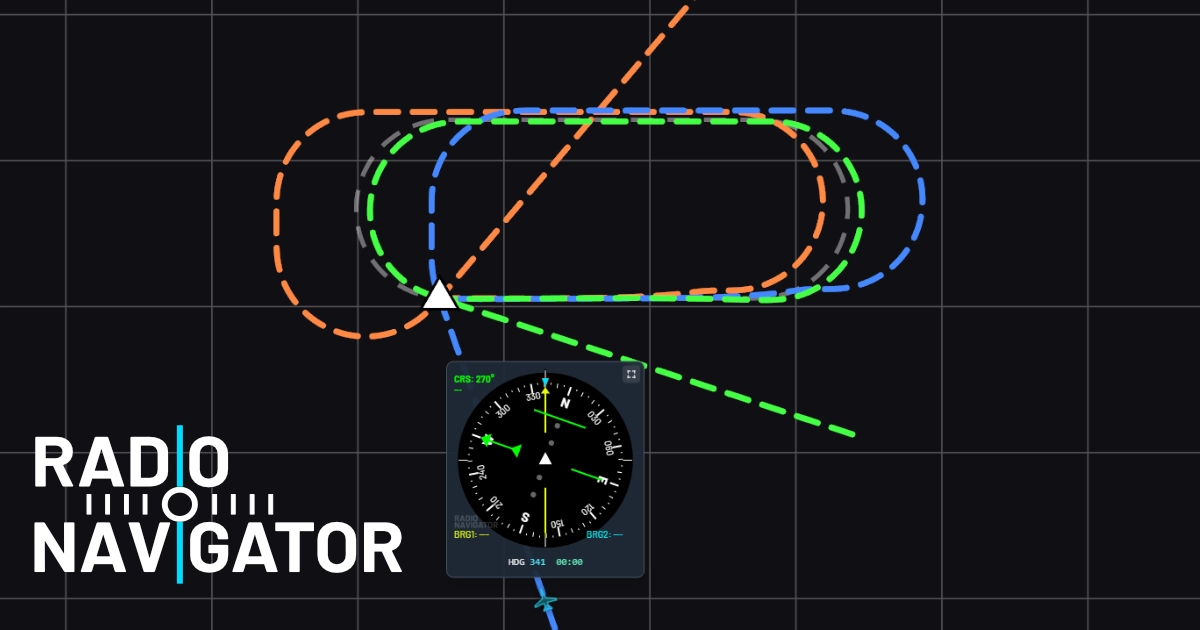
Direct entry walkthrough
A short walkthrough of the direct entry: one turn at the fix, then steady-state holding. Full transcript is below the video.
Video transcript
When the direct entry applies
The direct entry is the procedure for Sector 3, the 180° sector centred on the inbound course, tilted 20 degrees in the direction of the outbound turn[1]. It is the largest of the three sectors. For a standard right-turn hold with inbound course 270° it spans headings from 200° clockwise to 020° (180° of the compass rose), covering both the holding and non-holding sides.
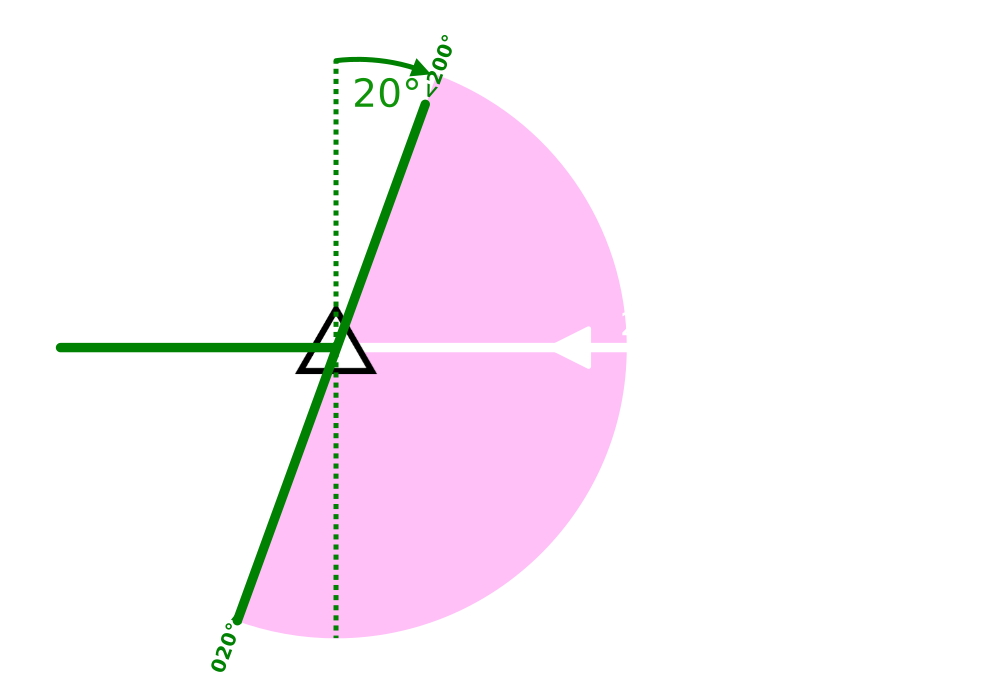
See how to determine hold entry for the full sector geometry and the HSI trick that lets you read the entry off your instrument in flight. If your heading at the fix falls instead in Sector 1 or 2, see the parallel entry or offset ("teardrop") entry.
How to fly the direct entry, step by step
- Track to the fix using whichever navaid the holding fix is based on.
- Bug the outbound heading before the fix. This is the reciprocal of the inbound course in nil wind.
- On crossing the fix, turn in the direction of the hold onto the outbound heading. Now you're in the hold!
- Start the timer abeam the fix on the outbound leg, or, if the abeam cannot be identified, when wings level on the outbound heading[1].
- Fly one wind-corrected minute outbound (1.5 minutes above 14,000 ft), or to the published limiting distance or radial.
- Turn in the direction of the hold to intercept the inbound course back to the fix.
Starting the timer: abeam vs wings level
ICAO Doc 8168 prescribes starting the outbound timer abeam the holding fix; where the abeam cannot be determined, the timer is started when wings level on the outbound heading[1]. FAA AIM 5-3-8 states the same rule[2].
- The abeam method is preferred because it gives a consistent outbound leg length. The abeam point is a QDR perpendicular to the inbound course. The Abeam QDR is inbound track + 90 for a RH hold, -90 for a LH hold.
- The wings level timer start applies when the abeam cannot be identified.
Wind correction on a direct entry
Because the direct entry is functionally the first lap of the hold itself, the same wind correction rules apply [1]:
- Triple drift on the outbound heading to compensate for drift across the outbound leg and the two turns.
- Adjusted outbound timing at approximately 1 second per knot of headwind or tailwind component (add time for a headwind on the outbound, subtract for a tailwind).
- Single drift inbound to maintain the inbound track to the fix.
Extreme direct entries
The direct sector is the largest of the three, so it covers a wide range of approach geometries. At one extreme, with heading nearly aligned with the inbound course, the entry is almost trivial. At the other extreme, with heading approaching the Sector boundary, the turn at the fix is large and the aircraft can end up tight in the hold. Set an arrival heading near the boundary in the hold visualiser and you can see how tight that first turn leaves you.
Extreme direct entries deserve their own technique. A dedicated tip article on extreme direct hold entries goes into the outbound corrections in detail.
Differences for FAA AIM
FAA AIM 5-3-8 prescribes the direct entry identically to ICAO Doc 8168: same Sector 3 geometry, same one-turn procedure, same abeam timing rule[2]. Standard differences across all three entries apply:
Common mistakes
- Not anticipating extreme direct entries. When your heading at the fix is close to the Sector 2/3 boundary (more than about 30° from the inbound track), the turn at the fix is either lesser or greater but taking you into the non-holding side, meaning you can be very tight inside the hold when over 30 degrees from inbound track. Anticipate this and consider correcting for it.
- Not using a wind-corrected outbound heading. The outbound leg of a direct entry needs the same wind correction as any other hold outbound leg: triple drift outbound and adjusted timing.
Practise this in the simulator
Use the simulator to practise this procedure. You can change the wind and monitor the instruments in your browser.
7-day free trial, no card required. Includes Just Fly, the Intercept Trainer and the Hold Visualiser. Reverts to the free tier when it ends; you are never charged automatically.
More about the tools for this topic:
- Hold Visualiser draws the direct entry from any arrival heading and shows the track the aircraft actually makes good.
- Holding Pattern Trainer generates random clearances and grades the entry and the pattern.
Check your understanding
Read each question. Decide on your answer. Then select Show answer to check it.
Show answer
Show answer
Show answer
Show answer
Frequently asked questions
When does the direct entry apply?
When your heading at the fix falls in Sector 3, the 180° sector centred on the inbound course.
How do you calculate the abeam QDR?
Inbound track + 90 degrees for a right-hand hold, -90 degrees for a left-hand hold. For a hold of 090LH it would be 090-90, 360° QDR. 090RH it would be 180°. This is where you would find yourself rolling out of a turn from a perfect inbound track in nil wind.
Is the direct entry always the easiest of the three?
It is the simplest manoeuvre (a single turn at the fix onto outbound), but it is not always tidy. Near the Sector 2/3 boundary the turn at the fix is large and the aircraft can end up tight against the inside of the hold. These cases, sometimes called "extreme direct" entries, benefit from a deliberate outbound correction.
How is wind correction applied in a direct entry?
Exactly as for normal holding. Apply triple drift to the outbound heading (the standard hold correction), adjust outbound timing by approximately 1 second per knot of headwind or tailwind, and apply single drift to maintain the inbound track. The direct entry is functionally the first lap of the hold itself.
When do I start the outbound timer?
Abeam the fix if the abeam can be identified, otherwise when wings level on the outbound heading (ICAO Doc 8168 Vol I §1.3.4 / §2.2.9; FAA AIM 5-3-8). Starting timing too early, at the start of the turn at the fix, gives a consistently short outbound leg and a tight inbound intercept.
Can I always choose the direct entry to keep things simple?
No. The published protected airspace around a holding pattern is sized on the assumption that you fly the entry corresponding to your heading at the fix. Choosing the direct entry from headings that belong in the offset or parallel sectors can place the aircraft outside the protected area, especially at high TAS or in strong wind. The entry is determined by heading, not by preference.
What is an "extreme direct" entry?
A direct entry where the heading at the fix is more than about 30 degrees from the inbound track and close to one of the Sector 3 boundaries: The turn at the fix is then large and the roll-out is uncomfortably tight inside the hold, calling for a deliberate outbound track correction. A separate article on extreme direct entries goes into the corrections in more detail.
Do FAA and ICAO treat the direct entry the same way?
Yes. The Sector 3 geometry, the procedure (turn outbound in the direction of the hold), and the abeam timing rule are identical in ICAO Doc 8168 Vol I §6 Ch 1 and FAA AIM 5-3-8.
Sources
- International Civil Aviation Organization, Procedures for Air Navigation Services: Aircraft Operations (PANS-OPS), Doc 8168, Volume I, Flight Procedures, Part II, Section 6, Chapter 2 (Holding Criteria), current edition. Not freely distributable; cited by document number and section.
- FAA Aeronautical Information Manual, Section 5-3-8, Holding. Current edition. faa.gov/air_traffic/publications/atpubs/aim_html/chap5_section_3.html
- Federal Aviation Administration, Instrument Flying Handbook (FAA-H-8083-15B), Chapter 10 (Departure, En Route, and Arrival Procedures), holding section. faa.gov/.../FAA-H-8083-15B.pdf
Related articles
This article is for study. Follow the instructions from your qualified flight instructor. Use current charts, procedures, and the regulations from your aviation authority.
© 2026 RHBA Radio Navigator. All rights reserved.