How to fly the parallel hold entry
By Rory Bennett (ATPL, FI: CPL, IR, ME, UPRT, FIC) · Published 15 May 2026
Direct answer
The parallel entry (ICAO Sector 1) applies when your heading at the fix falls in the 110° parallel sector. Cross the fix, turn in the OPPOSITE direction to the hold to a heading that gives the reciprocal of the inbound course as a free-air track, fly for one wind-corrected minute (1.5 minutes above 14,000 ft), then make a second turn in the same opposite direction to intercept the inbound course back to the fix[1].
| # | Step | What you do |
|---|---|---|
| 1 | Confirm Sector 1 | Confirm your heading at the fix falls in Sector 1 (the 110° sector, consider using the "thumb rule" on the HSI or DI.) |
| 2 | Cross the fix and turn outbound | On crossing the fix, turn in the OPPOSITE direction to the hold to a heading that gives you the reciprocal of the inbound course as a free-air track. |
| 3 | Start the timer | Start the outbound timer when wings level on the parallel heading. |
| 4 | Fly the wind-corrected minute | Fly the leg for one wind-corrected minute (1.5 minutes above 14,000 ft.) |
| 5 | Turn back to intercept inbound | At the end of the leg, make a further turn in the opposite direction to the hold to intercept the inbound course. Anticipate an intercept angle of about 45° at the start of the turn, and judge the roll-out so you arrive on the inbound track before the fix. |
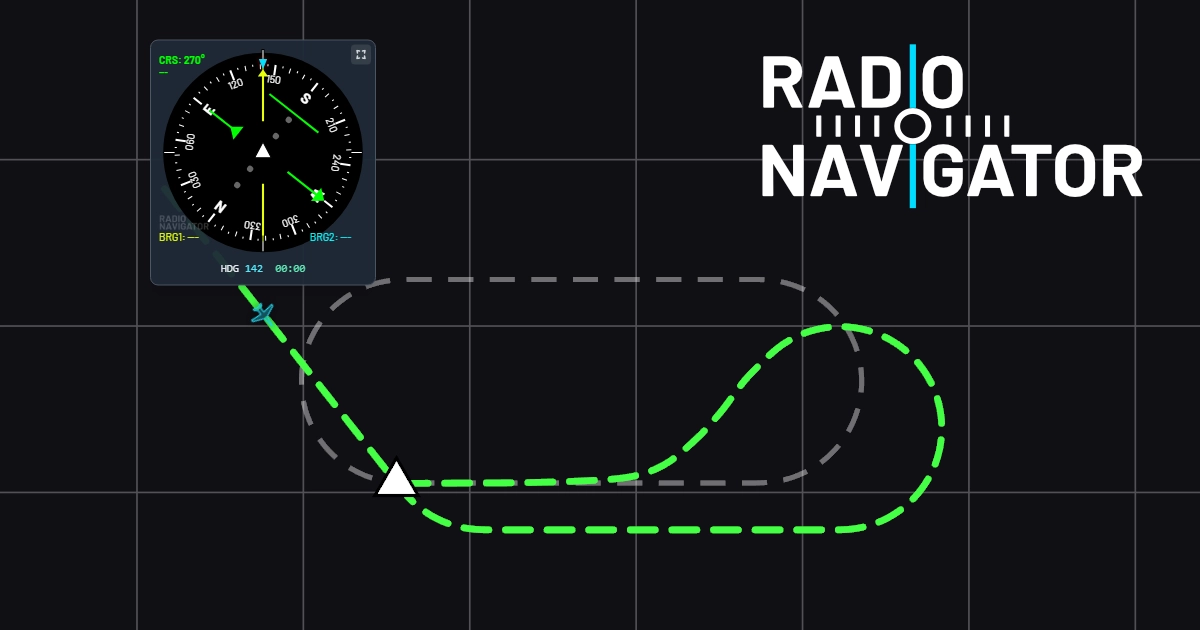
Parallel entry walkthrough
A 40-second walkthrough of the parallel entry: two turns, both opposite to the hold, with a wind-corrected outbound leg in between. Full transcript is below the video.
Video transcript
When the parallel entry applies
The parallel entry is the procedure for Sector 1, the 110° wide sector.[1]. It catches entries approaching from the other side of the hold from the inbound course, from the holding side. The goal is to fly reciprocal and parallel to the inbound (creating spacing to turn back) to then turn to establish the inbound track to the fix.
For a standard right-turn hold with inbound course 270°, Sector 1 spans headings from 090° to 200° (a 110° band).[1]. See how to determine hold entry for the sector geometry in full. If your heading at the fix falls instead in Sector 2 or 3, see the offset ("teardrop") entry or direct entry.
How to fly the parallel entry, step by step
- Track to the fix using whichever navaid the holding fix is based on (VOR, NDB, RNAV waypoint).
- When accurately tracking to the fix use the DI or HSI to determine entry sector based on heading.
- On crossing the fix, turn in the opposite direction to the hold to track the reciprocal of the inbound as a free air track. For a right-hand hold this is a left turn.
- Start the timer when wings level on the parallel heading.
- Fly one wind-corrected minute (1.5 minutes above 14,000 ft), or to the published limiting distance or radial[1].
- Turn again in the opposite direction to the hold to intercept the inbound course. The initial intercept angle is typically 45° but will vary with wind; roll out so the needle centres before you reach the fix.
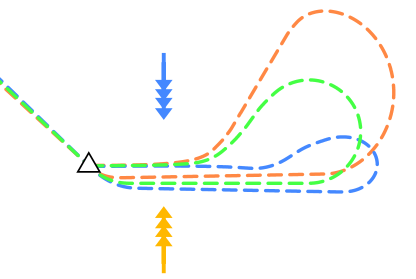
The first turn: opposite to the hold
Remind yourself approaching the fix for a parallel entry, the first turn should be flown in the opposite direction to the hold! (As should the second.)
The timed outbound leg
The parallel leg is a free-air track, not a tracked radial or bearing. You hold the heading that gives the reciprocal of the inbound course as your ground track, applying wind correction as you would on any free-air track.[1].
- Time: 1 minute at or below 14,000 ft; 1.5 minutes above. The leg is wind-corrected by adjusting the time (1 second per knot of headwind or tailwind component is common in light aircraft) and the heading (applying single drift)[1].
- Track: the reciprocal of the inbound course. Apply wind correction so the ground track is the reciprocal, not the heading.
- When to start timing: wings level on the parallel heading.
The intercept turn back to the inbound
At the end of the timed leg, make a second turn in the opposite direction to the hold and continue the turn past the reciprocal of the inbound course onto an intercept heading typically 45° across the inbound[1]. The angle through which you turn depends largely on wind, see the above diagram for an example, or draw the entry for any wind and arrival heading in the hold visualiser. Assess the RMI or CDI during the turn to determine how much of an intercept is required.
Judging when to roll out of the intercept is the hardest part of the parallel entry.
- Needle movement rate. A faster-moving needle means a steeper intercept and an earlier roll-out. A slow movement means more time on the intercept heading.
Worked example
Clearance: "Enter the hold at HLDER on the 090° radial, right turns, one minute outbound."
Setup: The 090° radial points east from HLDER, so the inbound course is 270°. Right turns → standard hold, holding side north of inbound. Outbound course is 090°.
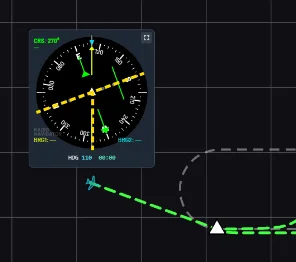
Approach: You arrive at HLDER on a heading of 110° in nil wind. This is just 20 degrees from the reciprocal of the inbound course, putting it in either the offset or parallel sector. In this case, you are flying more Southerly, placing it in the parallel entry sector - sector 1.
Procedure:
- Cross HLDER and turn LEFT (opposite to the right-turn hold) onto a heading of 090°.
- Wings level on 090°, start the timer.
- Fly 090° for one minute (nil wind, no correction needed).
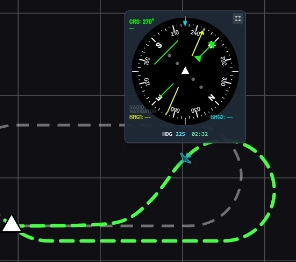
- At one minute, turn LEFT again, continuing through the inbound 270° onto an approximate intercept heading of 225° (45° across inbound).
- Roll out onto 270° as the needle centres, tracking inbound back to HLDER.
Total angle through the second turn: from 090° through 225° is 225° anti-clockwise, about three quarters of a full circle. This is typical for a parallel entry.
Is the non-holding side unprotected airspace?
This is a question students ask often, and the answer is no, but only for the entry. ICAO PANS-OPS holding-pattern protected airspace is sized on the assumption that you may fly any of the three published entries, including the parallel[1]. The protection on the non-holding side extends far enough to accommodate the timed leg of a parallel entry at standard holding speeds and wind.
Differences for FAA AIM
The parallel entry procedure under FAA AIM 5-3-8 is functionally identical to ICAO: same sector geometry, same two-turn structure, same opposite-direction turns, same timed leg[2]. The practical differences are the standard ones across all three entries:
- Bank angle ceiling: ICAO 25° or rate-one, whichever needs the lesser bank; the FAA instead offers a choice of rate-one, 30°, or 25° with a flight director[2][3].
- Timing break: FAA "at or below 14,000 ft MSL"; ICAO "at or below 14,000 ft". Numerically equivalent under standard atmosphere[2].
- 5° boundary tolerance: identical in both documents[1][2].
Common mistakes
- Turning the wrong way out of the fix. Normally both turns of a parallel entry are in the OPPOSITE direction to the hold. For a right-turn hold you turn left at the fix; for a left-turn hold you turn right.
- Tracking the inbound reciprocal as a radial or QDR. The parallel leg is a free-air track, not a tracked radial. Maintain the heading that gives you the reciprocal of the inbound course as your ground track, applying wind correction.
- Rolling out of the second turn on the inbound heading rather than an intercept heading. The second turn typically rolls out about 45° across the inbound course as an intercept, not parallel to it. Continue the turn until you are on a heading that intercepts the inbound, then judge the roll-out so the needle centres before the fix.
- Forgetting to start a timer. Remember overhead the fix: TTTTT "Twist, Turn, Time, Talk, Task."
- Treating the non-holding side as unprotected airspace. Holding protected airspace is sized to accommodate the parallel entry on the non-holding side. The protection is there by design, but only for one entry pattern, so do not loiter on that side. This misunderstanding often leads to people trying to track the inbound QDR instead of paralleling it, making the intercept later on much more difficult!
Practise this in the simulator
Use the simulator to practise this procedure. You can change the wind and monitor the instruments in your browser.
7-day free trial, no card required. Includes Just Fly, the Intercept Trainer and the Hold Visualiser. Reverts to the free tier when it ends; you are never charged automatically.
More about the tools for this topic:
- Hold Visualiser draws the parallel entry from your arrival heading, with the wind correction applied to the legs and the turns.
- Holding Pattern Trainer generates random clearances, quizzes the entry, and grades the pattern you fly.
Check your understanding
Read each question. Decide on your answer. Then select Show answer to check it.
Show answer
Show answer
Show answer
Frequently asked questions
Is the parallel entry the same as a teardrop?
No. The parallel entry (Sector 1) is flown approaching from the holding side of the inbound course, with the parallel leg on the non-holding side, with both turns in the OPPOSITE direction to the hold. The teardrop (sector 2, "offset") is flown approaching from the non-holding side as a 30° offset from the inbound QDR from the fix, with the final turn in the SAME direction as the hold. They are different procedures applied to different sectors.
Which direction do I turn out of the fix on a parallel entry?
Opposite to the hold. A standard (right-turn) hold becomes a LEFT turn out of the fix; a non-standard (left-turn) hold becomes a RIGHT turn. Both turns of the parallel entry, the first turn at the fix and the second turn at the end of the timed leg, are in the same opposite direction.
How long is the outbound leg of a parallel entry?
Standard timing: 1 minute at or below 14,000 ft (4,250 m), 1.5 minutes above, wind-corrected (ICAO Doc 8168 Vol I §2.2.9; FAA AIM 5-3-8). If the published procedure uses a limiting DME distance or radial, use that instead of timing.
What if my heading at the fix is right on the Sector 1 / Sector 3 boundary?
ICAO Doc 8168 Vol I §2.2.2 and FAA AIM 5-3-8 both allow a ±5° tolerance on the sector boundary. Within that band you may fly either the parallel or the direct entry. Pick whichever is simpler - the wind may guide your choice!
Is the non-holding side of a parallel entry protected airspace?
Yes, but only for the duration of the parallel entry manoeuvre. ICAO PANS-OPS holding-pattern protected airspace is sized on the assumption that you may fly any of the three published entries, so the non-holding side has a defined buffer to accommodate the parallel-entry timed leg.
How steep is the intercept turn at the end of a parallel entry?
Typically 45° at the start of the second turn, sometimes more (up to 60° is common) if you roll out wide due to underbanking or there is a strong wind from the non-holding side. The exact intercept depends on the wind on the outbound leg and how accurately you flew the reciprocal track. The judgement skill is partly how steep an intercept to pick, and partly knowing when to commence the turn onto the inbound heading from this intercept.
Sources
- International Civil Aviation Organization, Procedures for Air Navigation Services: Aircraft Operations (PANS-OPS), Doc 8168, Volume I, Flight Procedures, Part II, Section 6, Chapter 2 (Holding Criteria), current edition. Not freely distributable; cited by document number and section.
- FAA Aeronautical Information Manual, Section 5-3-8, Holding. Current edition. faa.gov/air_traffic/publications/atpubs/aim_html/chap5_section_3.html
- Federal Aviation Administration, Instrument Flying Handbook (FAA-H-8083-15B), Chapter 10 (Departure, En Route, and Arrival Procedures), holding section. faa.gov/.../FAA-H-8083-15B.pdf
Related articles
This article is for study. Follow the instructions from your qualified flight instructor. Use current charts, procedures, and the regulations from your aviation authority.
© 2026 RHBA Radio Navigator. All rights reserved.