How to use the gate in the hold
By Rory Bennett (ATPL, FI: CPL, IR, ME, UPRT, FIC) · Published 18 July 2026
Direct answer
The gate is a QDR offset 30° from the inbound QDR, toward the holding side. It marks where a light aircraft normally ends a one-minute outbound leg. Monitor time against the gate: reach the gate before the time and you are tight, so track up the gate to the time; reach the time before the gate and you are wide, so turn inbound and anticipate the intercept[1].
The gate explained in 30 seconds. Full transcript is below the video for accessibility and search.
Video transcript
What is the gate in a holding pattern?
The gate is an instructor technique for checking, on the outbound leg, whether your racetrack is spaced correctly. It is a QDR offset 30° from the inbound QDR, on the holding side, and it marks roughly where a light aircraft ends up at the end of a one-minute outbound leg[1]. Rather than waiting for the inbound turn to reveal a spacing error, you compare the gate against your outbound time and catch the problem while there is still time to fix it.
The word gate is not published in ICAO Doc 8168; it is a training aid. The geometry underneath it, however, is a standard ICAO hold: turns at rate one or 25° bank (whichever needs the lesser bank), a one-minute outbound leg at or below 14,000 ft (1.5 minutes above), and wind correction applied to both heading and timing[2].
How do you find the gate QDR?
Start from the inbound QDR: the radial you track along inbound to the fix, which is the reciprocal of the inbound track. If the inbound track to the fix is 090°, the inbound QDR is 270°. The gate is that QDR offset 30° toward the holding side, the side the racetrack lies on[1].
- Right-turn hold: the holding side is to the right of the inbound track. Offset the inbound QDR 30° that way. Inbound QDR 270° gives a gate of 240°.
- Left-turn hold: mirror it. The holding side is to the left, so the same inbound QDR 270° gives a gate of 300°.
The gate is a bearing from the fix. You read it on the RMI tail, the HSI course pointer, or the RNAV bearing to the fix. You are not flying it as a heading; you are watching for that radial to come up as the outbound leg runs.
How do you use the gate when outbound?
Once wings level outbound and timing, monitor both the clock and the gate QDR[1]. Whichever you reach first tells you how the spacing is developing.
Gate before time: you are tight
If the gate QDR comes up before your outbound time expires, the legs are too close together. Turn to track up the gate QDR and hold it until the time elapses, then turn inbound. Tracking out along the gate opens the spacing back to where it should be and puts you in the correct position to turn inbound[1].
Time before gate: you are wide
If your outbound time runs out before the gate QDR comes up, the legs are too far apart. Turn inbound now and anticipate an intercept: with the wider spacing you will meet the inbound track at a shallower angle, so lead the turn onto it rather than driving through to a large intercept[1].
Why the 30° gate works
The number is not arbitrary. A rate-one turn displaces the aircraft two turn radii across the inbound track, while the one-minute outbound leg runs it back along the track. The ratio of those two distances is the same at any light-aircraft speed, and it works out to an outbound endpoint about 32.5° from the inbound QDR on the holding side[2]. Rounding to a convenient 30° places the gate a shade inside the true endpoint, which is why reaching it early is a reliable early warning of a tight pattern.
How do you adjust the gate for wind?
The 30° gate is a nil-wind reference. Once you correct the outbound leg for wind, the aircraft rolls out on a different bearing from the fix, so the QDR you actually cross moves. As a rule of thumb it moves into wind by about single drift, the same drift angle you are already holding on the inbound leg. Look for the gate on that adjusted bearing, not on its nil-wind value[3].
Take a left-hand hold, inbound track 090° at 120 kt, wind from 180° at 30 kt. The nil-wind gate is the inbound QDR 270° plus 30° = 300°. On the inbound leg you are holding about 15° of drift. The gate moves 15° into wind, toward 180°, so you look for it near 285° rather than 300°. Reach that adjusted QDR before the time and you are still tight; run the time out before it and you are still wide[3].
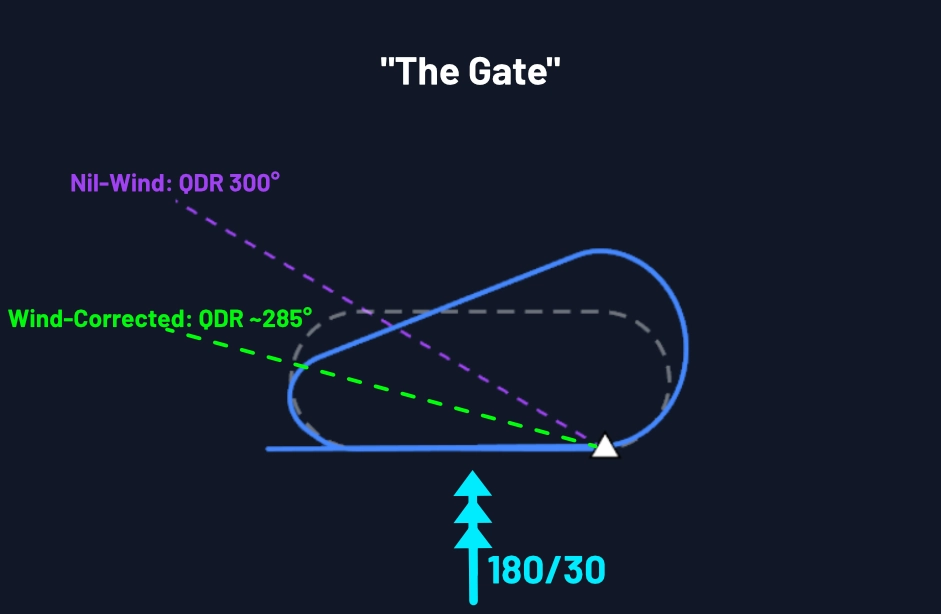
Single drift, the outbound heading (triple that drift, into wind), and the timing correction all come from the one measurement you take on the inbound leg. The companion wind correction in the hold article works the full method end to end.
Worked example: a tight outbound leg
Clearance: hold on the 270° radial of HLDER, right turns, one-minute legs.
Set-up: you track inbound along the 270° radial toward HLDER, so the inbound track is 090° and the inbound QDR is 270°. Right turns put the holding side to the south, so the gate is 270° − 30° = 240°. Outbound track is 270°.
Outbound: you cross HLDER, turn right onto 270° outbound and start the timer wings level. You watch the RMI tail for the 240° gate and the clock for one minute.
The catch: at 45 seconds the RMI tail reaches 240°, the gate, with 15 seconds still to run. Gate before time, so you are tight. Turn to track up the 240° QDR and hold it until the minute is up, then turn inbound. The extra tracking along the gate restores the spacing for a clean intercept of the 090° inbound track.
Worked example (you finish it)
Same skill, one step left to you. Read the set-up, decide the answer, then reveal to check.
Clearance: hold on the 270° radial of TOPAS, left turns, one-minute legs.
Set-up: inbound track 090°, inbound QDR 270°. Left turns, so the holding side is to the north.
Question: what is the gate QDR, and if your one-minute time expires while the RMI tail still reads 285°, are you tight or wide, and what do you do?
Show the answer
Left turns put the holding side north, so the gate is 270° + 30° = 300°.
The time has expired but the tail reads 285°, short of the 300° gate, so you reached the time before the gate: you are wide. Turn inbound now and anticipate the intercept, leading the turn onto the 090° inbound track because the wider spacing gives a shallower closing angle.
Where the gate fits in the hold
The gate is a companion to the two things it sits between. It builds on holding pattern timing (the outbound clock the gate is compared against) and feeds the inbound turn (catching a spacing error on the outbound leg means the inbound turn starts from the right place). If wind is the reason the spacing keeps going wrong, see wind correction in the hold.
Common mistakes
- Offsetting the 30° to the wrong side of the inbound. The gate always sits on the holding side, the side the racetrack lies on. For a right-turn hold that is the right of the inbound track; for a left-turn hold it is the left. Offset the wrong way and the gate points across the non-holding side, where the aircraft never goes.
- Treating the gate as a heading to fly rather than a QDR to read. The gate is a bearing FROM the fix, read off the RMI, HSI course pointer, or RNAV bearing. You are watching for that radial to come up as you fly the outbound leg. Only when correcting a tight pattern do you turn to track along it.
- Reading tight or wide as distance from the fix instead of leg spacing. Tight and wide describe the gap between the inbound and outbound legs, not how far the aircraft is from the fix. A wind that pushes you further from the fix can still leave the legs too close, and the gate is what tells you which.
- Applying the 30° gate at high true airspeed without adjustment. The 30° figure assumes a rate-one, one-minute outbound leg in a light aircraft. The true geometric offset is about 32.5° at rate one and grows above roughly 170 kt TAS, where a 25° bank limit takes over from rate one. Fast aircraft need a wider offset.
- Looking for the gate on its nil-wind bearing in a crosswind. The 30° gate is a nil-wind reference. Once the outbound leg is wind-corrected, the QDR you actually cross moves into wind by about single drift, the same drift you read on the inbound leg. Expect the gate on that adjusted bearing, or you will misjudge tight against wide.
Practise this in the simulator
Use the simulator to practise this procedure. You can change the wind and monitor the instruments in your browser.
7-day free trial, no card required. Includes Just Fly, the Intercept Trainer and the Hold Visualiser. Reverts to the free tier when it ends; you are never charged automatically.
More about the tools for this topic:
- Hold Visualiser lets you drag the aircraft to any point in the pattern and read the instrument indications there.
- Holding Pattern Trainer grades the inbound intercept, which is what the gate exists to get right.
Check your understanding
Read each question. Decide on your answer. Then select Show answer to check it.
Show answer
Show answer
Show answer
Show answer
Frequently asked questions
What is the gate in a holding pattern?
The gate is a feature used in holding to correct for being tight or wide outbound. It is a QDR offset 30° from the inbound QDR, and is where you normally end up at the end of the outbound leg in a light aircraft.
How do you find the gate QDR?
Take the inbound QDR (the radial you track inbound to the fix) and offset it 30° toward the holding side, the side the racetrack lies on. For a right-turn hold with inbound QDR 270° the gate is 240°; for the same hold with left turns it is 300°.
How do you use the gate when outbound?
Monitor for time and gate outbound. If you reach the gate before your outbound time, you are tight: turn to track up the gate to the time, which puts you in the correct position to turn inbound. If you reach the time before the gate, you are wide: turn inbound and anticipate an intercept.
How do you adjust the gate for wind?
The 30° gate is a nil-wind reference. Once you wind-correct the outbound leg, the QDR you actually roll out on moves into wind by approximately single drift, the same drift you read on the inbound leg. Look for the gate on that adjusted bearing. For a left-hand hold, inbound track 090°, wind 180° at 30 kt, the nil-wind gate is 300° and with about 15° of drift you find it near 285°.
Is the gate an official ICAO holding procedure?
No. The term gate is an instructor technique, not published in ICAO Doc 8168. The underlying geometry is consistent with a standard ICAO hold: a rate-one, one-minute outbound leg in a light aircraft ends about 32.5° from the inbound QDR, which the technique rounds to a convenient 30°.
Is the gate the same as the offset (teardrop) entry QDR?
The 30° offset is the same number used for the offset entry sector, but the gate is a different idea. The offset entry uses the 30° QDR on the entry leg only; the gate uses it every circuit, as a steady-state check on outbound spacing before the inbound turn.
Does the gate work at any speed?
It is designed for light aircraft flying a rate-one turn, where the offset is speed-independent at about 32.5°. Above roughly 170 kt TAS a 25° bank limit takes over from rate one and the offset grows, so a fast aircraft needs a wider gate than 30°.
Sources
- Good Flying Made Easy, Holding: "The Gate". youtube.com/watch?v=uMMduy4izLg
- International Civil Aviation Organization, Procedures for Air Navigation Services: Aircraft Operations (PANS-OPS), Doc 8168, Volume I, Flight Procedures, Part I, Section 6, Chapter 1 (Holding Criteria), current edition. Bank angle and rate of turn (para 1.3.2), wind correction (para 1.3.3), outbound timing (paras 1.4.9 and 1.5.1). Not freely distributable; cited by document number and section.
- Good Flying Made Easy, Holding: ICAO PANS-OPS. Source for the single-drift wind adjustment of the gate (the gate moves into wind by approximately single drift). youtube.com/watch?v=3ux5d7xAg3Y
Related articles
This article is for study. Follow the instructions from your qualified flight instructor. Use current charts, procedures, and the regulations from your aviation authority.
© 2026 RHBA Radio Navigator. All rights reserved.